

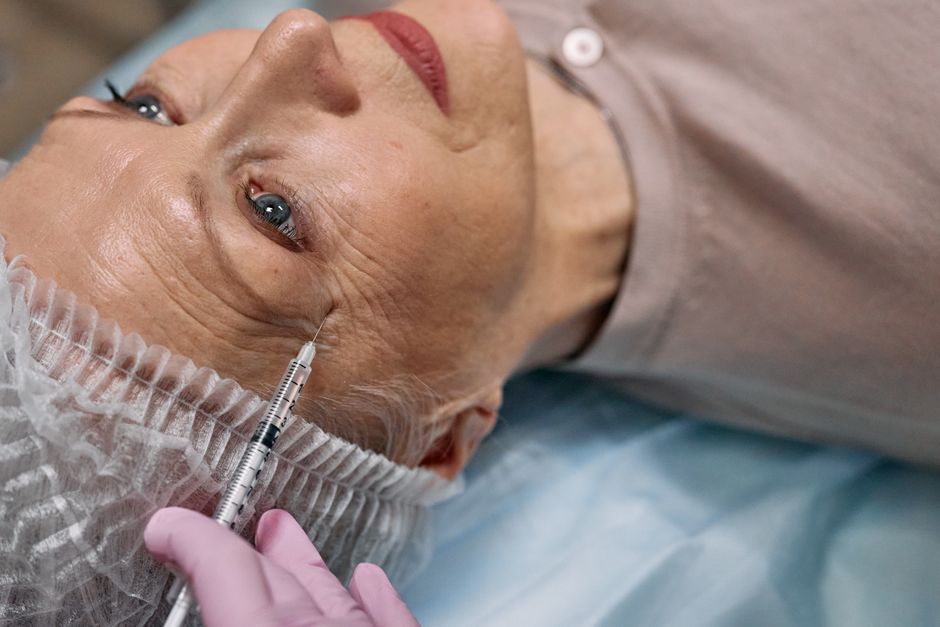
Botox injections reduce certain wrinkles by temporarily relaxing the small facial muscles that create repeated creasing. The treatment is most effective for expression-related lines, such as frown lines between the eyebrows, horizontal forehead lines, and crow’s feet beside the eyes.
Botox does not fill wrinkles, rebuild lost skin volume, or permanently stop aging. Instead, it decreases muscle activity so the overlying skin folds less often and may appear smoother.
What is Botox, and how does it affect facial muscles?
Botox is a purified form of botulinum toxin type A used in very small, controlled amounts. It works by blocking the release of a chemical signal that tells a targeted muscle to contract.
After an injection, the treated muscle gradually becomes less active. The skin above that muscle is pulled and folded less frequently, which softens the appearance of dynamic wrinkles. These are lines caused primarily by repeated expressions such as smiling, squinting, frowning, or raising the eyebrows.
The treatment does not remove the ability to feel the skin. It also does not necessarily eliminate facial expression. A carefully planned treatment generally aims to reduce excessive muscle movement while preserving a natural appearance.
Which wrinkles respond best to Botox?
Botox is most useful for wrinkles that become more noticeable during facial movement. Common treatment areas include:
- Frown lines between the eyebrows, sometimes called glabellar lines
- Horizontal forehead lines
- Crow’s feet, or lines at the outer corners of the eyes
- Certain vertical neck bands, depending on the product, anatomy, and treatment plan
Wrinkles caused mainly by sun damage, skin laxity, dryness, or loss of facial volume may not respond as well to muscle relaxation alone. For example, a crease that remains visible when the face is completely relaxed may involve changes in the skin itself rather than muscle activity.
This distinction matters for residents in Meridian, where bright sun, dry air, and outdoor exposure can contribute to skin dehydration and cumulative ultraviolet damage. Daily sun protection and a basic skin-care routine address factors that injections do not.
What happens during an injection treatment?
A treatment usually involves a brief examination of facial movement, followed by several small injections into selected muscles. The number and placement of injections depend on the treatment area, muscle strength, facial proportions, existing asymmetry, and the desired degree of movement.
The needle is typically very fine. Most people describe the sensation as a brief pinch or sting. Mild redness, swelling, tenderness, or pinpoint bleeding can occur at the injection sites.
Botox is not a dermal filler. A filler adds volume beneath the skin, while Botox changes muscle activity. The two treatments address different types of facial aging and should not be treated as interchangeable.
How soon do results appear?
Results usually develop gradually rather than appearing immediately. Some people begin noticing a change within several days, while the full effect may take about one to two weeks.
The treated area may look smoother during expression, but the result can vary. Factors include the strength of the muscles, the depth of the existing lines, the amount injected, individual metabolism, and whether the wrinkles are caused by movement, skin damage, or volume loss.
A first treatment may also serve as an adjustment period. The response can help determine whether future treatment should use a similar amount or a different distribution.
How long does Botox last?
The wrinkle-reducing effect commonly lasts about three to four months, although some people experience a shorter or longer duration. Muscle activity gradually returns as the body forms new nerve connections and the medication’s effect wears off.
Stopping treatment does not usually make the face permanently more wrinkled than it would have been without Botox. The treated muscles generally regain movement, and the skin returns toward its previous pattern over time.
Repeated treatments may produce a longer-lasting appearance of relaxation in some people because the targeted muscle can become less developed with reduced use. This is not guaranteed, and regular treatment should still be based on individual medical assessment rather than a fixed schedule.
Does Botox make the face look frozen?
A frozen appearance is not an unavoidable result. It is more likely when too much product is used, injections are placed too broadly, or normal differences in facial movement are not considered.
Natural-looking results depend on balancing wrinkle reduction with useful facial motion. For example, some people may want forehead lines softened while retaining some eyebrow movement. Others may prefer more complete relaxation of a strong frown muscle.
Facial anatomy also varies. A brow or eyelid may appear lower if nearby muscles are weakened unevenly. Careful evaluation is particularly important for people who already have heavy eyelids, low eyebrows, facial asymmetry, or a history of eyelid drooping.
What side effects can occur?
Most side effects are temporary and related either to the injection or to nearby muscle relaxation. They may include:
- Bruising, redness, swelling, or soreness
- Mild headache
- Temporary brow or eyelid drooping
- Uneven eyebrows or an altered smile
- Dry or watery eyes
- Localized weakness near the treatment area
Rarely, the toxin can spread beyond the intended area and cause more serious symptoms. Trouble swallowing, speaking, breathing, seeing, or controlling facial or other muscles requires prompt medical attention.
Botox should not be injected into an area with an active infection. People should also disclose pregnancy or breastfeeding, neuromuscular disorders, swallowing or breathing problems, previous reactions to botulinum toxin, and all medications or supplements that may affect muscle activity or bruising.
What should someone consider before treatment?
A qualified medical injector should review the person’s goals, medical history, medications, previous injections, and facial anatomy. Product units are not directly interchangeable among different botulinum toxin products, so a number quoted for one product should not automatically be compared with a number for another.
It is also wise to ask which facial lines the treatment is expected to improve and which concerns may require a different approach. Botox cannot correct every wrinkle, tighten loose skin, remove pigmentation, or replace a consistent sun-protection routine.
Following treatment, many people return to ordinary activities quickly. Avoiding rubbing or massaging the injected areas and postponing strenuous activity for a short period may be advised to reduce unwanted spread. Specific aftercare instructions can vary according to the treatment plan.
For local households, timing may matter during hot, dry stretches of the year. Outdoor work, exercise, sun exposure, and activities that increase sweating or require frequent face wiping can make aftercare less convenient, even though they do not determine whether Botox will work.
Is Botox a permanent wrinkle treatment?
No. Botox temporarily reduces the muscle activity that contributes to selected wrinkles. As movement returns, the lines may gradually become more visible again.
The most realistic expectation is maintenance rather than permanence. Results are usually subtle when treatment is appropriately planned, and the benefit depends on matching the procedure to the type of wrinkle being treated. Protecting skin from ultraviolet exposure, avoiding tobacco, using moisturizer, and following a consistent skin-care routine can support overall skin health, but these habits do not produce the same muscle-relaxing effect as Botox.
Understanding the difference between movement-related wrinkles and changes caused by sun exposure, dryness, laxity, or volume loss is the key to deciding whether Botox is likely to address a particular concern.